

SAP landscapes are changing quickly. Along with organisations modernising their ERP environments and making the transition to cloud operations, application monitoring is also gaining significance. Businesses that have been using SAP Solution Manager for years should think about changing the way they monitor and manage their applications’ lifecycle.
As the transition deadline approaches for the year 2027, customers are asking themselves about the impact of the transition on daily monitoring, operations and application management tasks when using SAP Cloud ALM and Solution Manager.
It’s not about which platform is newer; it’s about which platform is better. It’s a matter of selecting a solution that fits into the organization’s SAP environment and long-term plans.
Understanding SAP Solution Manager
SAP Solution Manager has always been the hub of SAP environments and is used for managing and monitoring. It can be used for system monitoring, application operations, IT service management, change management, and implementation-related activities.
If enterprises already have an on-premise SAP landscape, Solution Manager may already have found a deep place in the processes.
But maintaining a traditional monitoring environment may involve technical administration, configuration, infrastructure management and continued maintenance. Organisations are now questioning whether their current tools and processes will still work well in their future cloud-fueled landscape, as SAP customers move more and more to cloud technologies.
But what is SAP Cloud ALM?
SAP Cloud ALM is SAP’s Application Lifecycle Management (ALM) cloud-based platform to help implement and operate cloud-based SAP applications.
It includes features for monitoring, the management of implementations, business process monitoring, integration monitoring, etc.
Cloud ALM is a cloud-based model as opposed to a traditional platform that organizations would have to work within their infrastructure. This can help to lower the number of infrastructure and admin tasks for keeping an on-premises lifecycle management platform.
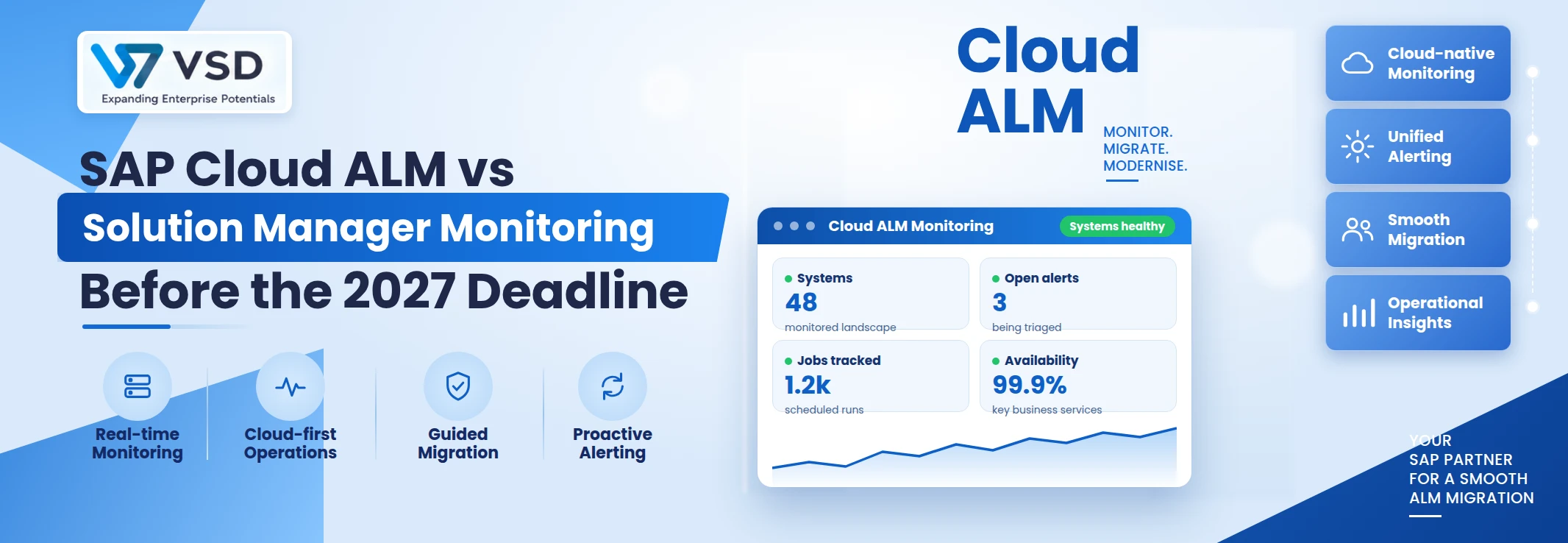
SAP Cloud ALM vs Solution Manager for Monitoring
The difference is highlighted when considering the operational model.
For a long time Solution Manager has offered wide-ranging functionalities in complex SAP landscapes. It can be used to handle in-depth tracking and administration needs, especially in established on-site settings.
Cloud ALM, on the other hand, is developed with modern cloud operations in mind. It offers a more efficient way to monitor SAP applications and business processes in the cloud.
Thus, when considering SAP application monitoring services in India, it is not just the monitoring features that need to be taken into account. All of these factors impact the best way to do it: the SAP landscape, deployment model, operational needs, internal expertise, and future migration plans.
The significance of the 2027 timeline.
For SAP customers who are using Solution Manager, the 2027 timeframe has been an important planning milestone. It’s never too late to find out how the way organisations currently monitor will change.
Transitioning goes beyond just picking a new platform. Business must define elements of monitoring activities, existing integrations, alerts, reports, operational procedures and responsibilities.
Additionally, they’ll have to identify what can be pushed directly to Cloud ALM and in which areas processes might need to change.
Conducting this evaluation early will enable the IT staff to document the current environment, understand where they are missing, test new processes and train users who will be involved.
What are the factors to consider before relocating your business?
Organisations should consider a number of factors before making a transition decision:
Identify on-premise, cloud, hybrid and third-party systems to monitor in the current SAP landscape.
- Monitoring needs: Record the needs for monitoring the application, integration, infrastructure, and business processes.
- Current Solution Manager adoption: Identify Solution Manager features that are being used and which features are no longer needed.
- Integration dependencies: Examine relationships between SAP systems, external applications, monitoring applications, and IT service management applications.
- Operational skills: Determine if existing teams will be able to use the future monitoring environment.
A structured assessment can help to ensure a more predictable transition and minimize the impact on operations.
The SAP Application Lifecycle Management Partner's role.
Technology transitions can entail more than just installing a new platform, and they may include a change in technology and operations. An already proven SAP application lifecycle management partner can assist companies evaluate their current situation, determine what they need to monitor, plan the transition and put in place suitable processes and procedures.
The partner can also be involved in application monitoring, incident management, integration monitoring, performance analysis and continuous optimisation.
This can be especially beneficial for enterprises with intricate SAP environments where internal departments are already handling numerous applications and business-critical systems.
Getting Ready for the Next Phase of SAP Operations
The transition from Solution Manager to Cloud ALM should be viewed as a time to take a fresh look at the monitoring and management of SAP applications. Organisations don’t have to replace one tool with another, but rather can leverage the transition to streamline processes, enhance visibility and integrate application operations with their overall cloud strategy.
Early evaluation and effective operational planning can help pave the way for businesses embarking on SAP application monitoring India projects.
Conclusion
SAP Cloud ALM and Solution Manager are two different concepts of application lifecycle management and monitoring. It will depend on an organisation’s SAP architecture, operational needs, cloud adoption plans and transition journey.
As the 2027 deadline nears, companies should review their existing monitoring systems before rushing into the transition and adopting new technology. The road to managing SAP application life cycles has been paved with cooperation and collaboration with VSD Technologies, where you can evaluate your SAP environment, plan for the monitoring transition and develop an application lifecycle management plan based on your future SAP roadmap.
📩 Contact us today to start your automation journey.
🌐 www.vsdtechnologies.com