


Modern businesses rarely operate through a single application. ERP systems, CRM platforms, cloud applications, partner portals, mobile apps, and internal tools all need to exchange information. When these systems operate in isolation, teams often end up dealing with duplicate data, manual processes, and disconnected workflows.
SAP Integration Suite helps organisations address this challenge by providing tools to connect applications, data, APIs, and business processes. Within this ecosystem, API Management plays an important role in controlling how APIs are created, published, secured, monitored, and consumed.
For businesses looking to modernise their integration landscape, understanding how these capabilities work together is an important starting point.
What is SAP Integration Suite?
SAP Integration Suite is a cloud-based integration platform to connect SAP and non-SAP applications, systems, data sources, and business processes.
It can be used in different integration scenarios – from an organisation that wants to integrate SAP S/4HANA with a third-party application to the creation of a widespread hybrid integration landscape.
Orgs can create a more formal integration architecture rather than creating a connection for each system. This facilitates the exchange of information and also helps when business requirements change.
So where does API Management come into play?
APIs are a standardised method of communication between applications and services. But just making APIs is not enough. There are also access, security, usage, performance and lifecycle requirements that organisations should handle.
Organisations can use SAP API Management and Integration services in Canada to set up a structured way of connecting via APIs.
Businesses can use SAP API Management to make certain services available via an API and manage access to the APIs. Security policies can be applied to teams, API versions can be managed, usage can be monitored, and the way enterprise services are consumed can be provided in a consistent manner to developers.
This is especially useful if there are a number of applications to access information from and a third party to be controlled by the organisation.
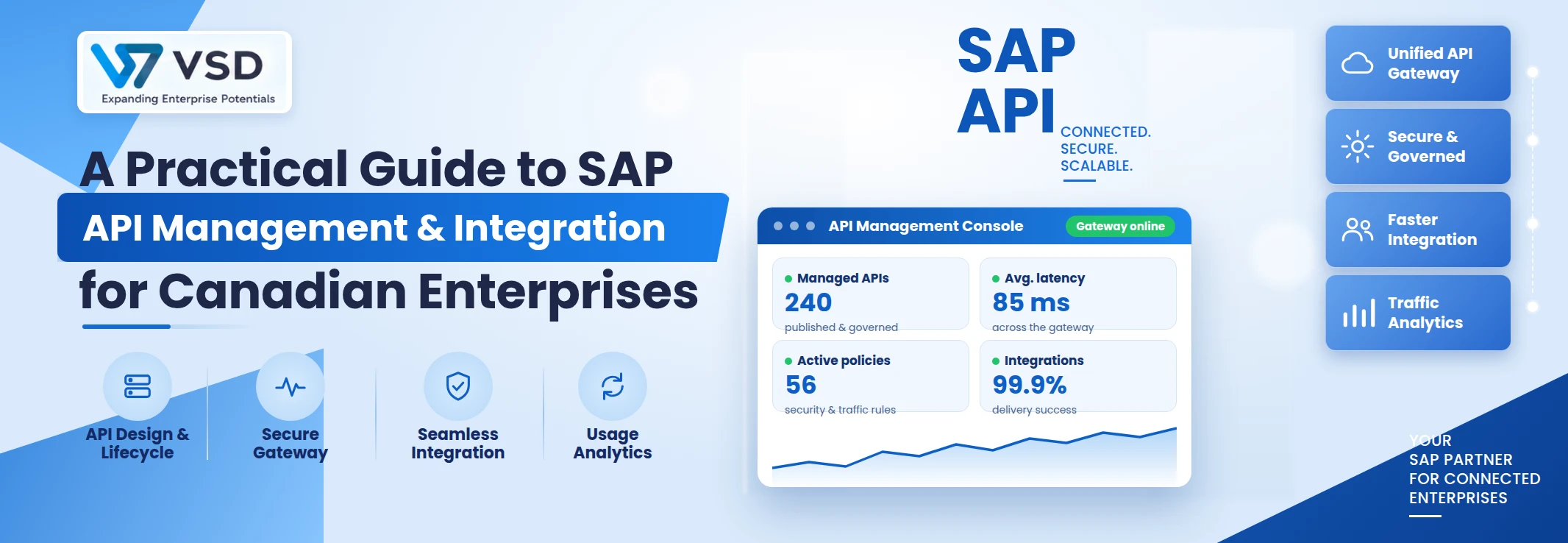
Key Capabilities of SAP API Management:
API Management enables a number of important activities through the various stages of the API lifecycle.
- API security: Businesses can deploy authentication and authorization policies to shield vulnerable services and data.
- API publishing: APIs can be published using managed channels, which helps to increase their visibility to approved developers and apps.
- Traffic management: Policies can be used to manage API traffic and prevent backend systems from being flooded or bombarded with unnecessary requests.
- Monitoring and analytics: Usage data can be used to gain insight into API usage, error rates, and consumption trends.
- API lifecycle management: Organisations can control API versions and updates, and minimise disruption to existing consumers.
These features enable APIs to be used as a governed enterprise asset instead of a technical connection.
The issue with integration and API management is that they are two sides of the same coin. The point is, integration and API management are two sides of the same coin.
Integration and API management solve separate aspects of the challenge of integration, but they complement each other very well.
Integration: Links systems together and coordinates the flow of information. API Management is the control of service exposure and consumption.
SAP S/4HANA can be used, for instance, for the storage of customer data, whereas the application on the customer side may run on another platform. An integration flow can enable systems to communicate with each other, and API Management can manage the exposure of the needed services to the application.
This will help to make it easier to distinguish backend systems from the applications that use their services.
Support Hybrid and Cloud Environments
Most business organisations have a mix of cloud-based applications, on-premises applications and third-party applications. It’s hard to replace everything at once.
SAP Integration Suite can assist in this gradual switch by enabling organizations to integrate their current systems with newer cloud-based apps.
This can be particularly useful when modernizing SAP environments, as companies will have to integrate current applications and gradually move towards cloud-based solutions.
A comprehensive SAP API management and integration strategy in Canada can thus help with current connectivity needs and future digitalisation initiatives.
What is the business to take into consideration prior to implementation?
Technological solutions are part of an effective integration solution, but not the only component. The first step in establishing a data exchange between systems is to determine which systems must communicate, what data to exchange, and who should have access to each service.
Security requirements must be established as early as possible, especially if the API shares enterprise data that needs protecting. Other standards that should be established at an organization include documentation, monitoring, versioning, and ownership.
Having a well-defined integration model from the get-go will avoid needless point-to-point connections and will simplify future expansion.
Connecting a More Connected SAP Landscape
Organisations can gain a structured basis to connect applications, manage API, and enable modern business processes with SAP Integration Suite and API Management. What is truly valuable is not just the ability to do integration, but the ability to apply those capabilities to specific business needs.
Canadian businesses can benefit from adopting the right SAP API management and integration strategy in order to achieve improved connectivity across their systems, while maintaining security, scalability, and future-proof plans to modernise their systems.
Conclusion
Reliable integration is becoming one of the most important aspects of enterprise technology landscapes these days. In a digital world, SAP Integration Suite and API Management empower businesses to connect systems, manage APIs and create more agile digital ecosystems. Engage with VSD Technologies to discover how a realistic SAP integration and API management solution can ease connectivity and enable your organisation to prepare for future growth.
📩 Contact us today to start your automation journey.
🌐 www.vsdtechnologies.com